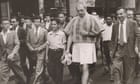
He donned a skirt to shock his conservative countrymen – and got bundled into a police station for his own protection. As his work appears in the Royal Academy’s Brasil! Brasil! show, we celebrate a luminary of modernism
In 1931, as the Corpus Christi parade made its way through central São Paulo, the Catholic faithful found a tall man walking in the opposite direction. As he went, Flávio de Carvalho flirted with the men, and refused all calls for him to cease his disruption.
The Dada-inspired Experience N. 2, which ended with De Carvalho bundled into a police station for his own protection, was the first example of performance art in Brazil. Yet its instigator never achieved the international fame his artist peers did, perhaps because of his refusal to make work that chimed with trends. “The performances were very provocative and raised a lot of eyebrows in what was a very conservative Catholic country; he was also so restless, moving from art to architecture, to journalism. It was hard to place him,” says Adrian Locke, chief curator at the Royal Academy. “Abnormal art is the only good art,” De Carvalho himself countered.