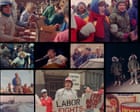
Since the release of defining 70s doc Harlan County, USA, film-makers have captured workers’ tenacity and solidarity
“We better start pulling together or, by God, they’re going to bury us,” says a meat packer during a union meeting in Barbara Kopple’s 1990 documentary American Dream. It’s a desperate plea for survival; “they” are the Hormel Foods Corporation, who took advantage of union disorder to replace a huge portion of their workforce during a costly strike. American Dream sees the 1985-86 labor crisis in Austin, Minnesota, as symbolic of the state of organized labor in the United States – call it an alternative State of the Union address.
American Dream takes place in the Reagan years, characterized by an uncompromising approach to union power: in 1981, the president threatened striking air traffic controllers with termination if they didn’t return to work in 48 hours; private companies like Hormel, Phelps Dodge, and International Paper increasingly replaced striking workers; and unions lost 2.7 million members from 1980 to 1984.