Somerset House, London
Escher’s paradoxical geometries and impossible gravities may baffle the mind – yet even his wildest works were never just fanciful, as this fun and gripping show makes clear
We think we know the world of Maurits Cornelis Escher with its mind-bending staircases and buildings that impossibly twist upon themselves. Yet a shocking glimpse of reality intrudes in Somerset House’s gripping journey through his metaverse. In 1945, Escher designed a diploma for students at a temporary academy in Eindhoven, recently liberated from Nazi rule. Behind a wise old owl in the foreground, twisting columns of black smoke rise from a riverside town, their evil sinuousness reflected in the water. The message of this depiction of war is not only that Escher was a civilised individual surviving a brutal age but also that his visual delights were never just fanciful. Even his wildest speculations reveal the workings of the world itself, grounded as they are in what Galileo called “the language of mathematics” in which “the book of nature is written”.
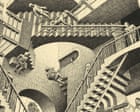
You don’t have to be fluent in that language to lose yourself in Escher’s art. You just need to look, and this exhibition lets you look so much more closely and deeply than you can in books and reproductions and imitations of his work. At times you feel you are actually inside his paradoxical places. I chuckled for ages in front of his 1958 lithograph Belvedere in which a king and queen survey a mountainous landscape in different directions from two storeys of a Renaissance building, but wait, they don’t just face different ways, their separate floors are totally at odds, the king’s pointing sideways while the queen faces out of the picture in a 90-degree shift: the columns on the front of the king’s balustrade support the back of the queen’s floor and the whole building turns in two different dimensions inhabiting two truths at once. No wonder the builders are dressed as jesters while an architect sits studying geometry.