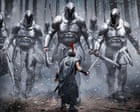

Charlie Chaplin uses humour to show the horrors of Hitler’s Germany in The Great Dictator (Photo: WikipediaCommons)
The Great Dictator, 1940
The Great Dictator was banned in Germany and Nazi-occupied countries when it was released in 1940, which is unsurprising given its direct mockery of Adolf Hitler.
Charlie Chaplin was even warned that it might face difficulties in Britain and US, but he remained committed to making the film because he believed its message was important.
He was right—the film became a major commercial success and the second highest-grossing film in the US in 1941.
Beyond its success as a comedy, the film stands out for its remarkably accurate portrayal of Hitler’s personality and authoritarianism.
Chaplin was openly opposed to the Nazis and actively supported Jewish refugees, making this his most overtly political work.
Through the parallel stories of a persecuted Jewish barber and the dictator, Chaplin ensured audiences never lost sight of both the victims and the source of the oppression.
The Great Dictator uses humour to expose the atrocities of Nazism and ends in a Brechtian way with no neat resolution. The speech scene comprised long, uninterrupted camera shots. Chaplin made the film as anti‑fascist propaganda.
Some critics have argued that the film trivialised Nazi atrocities. And Chaplin later acknowledged that he could not have made the same film had he known the full horrors of the concentration camps.
Chaplin wanted audiences to see the Nazis as a threat to humanity. Given his enormous popularity and influence, he was uniquely positioned to do that.

The Four Days of Naples, 1962
This is a neglected masterpiece. It stands in the tradition of Italian neorealism, with Roberto Rossellini’s Rome Open City and Paisan before, and Pontecorvo’s iconic The Battle of Algiers after.
The film was shot on location in the streets of Naples with non‑professional actors bringing working class authenticity to the screen. The film’s producers emphatically stated that the “stars” of the film are “the people of Naples”. The film was a tribute to them and to those who died fighting.
Faithful to neorealism, director Nanni Loy’s tribute to the resistance in Naples reconstructs the urban warfare with rare authenticity and tension.
This is done with impressive low-angle shots as well as deep focus long shots.
As Loy avoids recourse to rapid cuts, he also minimises the presence of film icons such as Lea Massari and Gian Maria Volonté. The professional cast of actors agreed to omit their names from the film’s credits.
One of the greatest myths about the Second World War is that Allied armies liberated Europe from Nazism on their own. The truth is that ordinary working class people did it.
Naples was the first to rise up against German control, with four days of street battles forcing the occupiers out as the Allies arrived on the mainland in September 1943.
11 year old partisan Gennaro Capuozzo was killed fighting against the Nazis. He was taking part in the successful four-day insurrection in the city against Nazi occupation and was killed while throwing hand grenades at German tanks.
This is an inspiring story. A largely inexperienced movement took on vastly superior military and economic forces and fought them to a standstill.

Land and Freedom, 1995
The memory of the Spanish Civil War is an important part of the anti-fascist tradition in Britain.
Hundreds of British workers went to fight in Spain against fascism. At the same time the British state had a rotten record, unofficially supporting
Francisco Franco and pushing the hypocritical sham of international non-intervention.
In Land and Freedom, the Liverpudlian David Carr goes to fight against Franco. Rather than joining the Stalinist International Brigade, he enlists with Trotskyist splinter group, the POUM.
For Ken Loach, a director of considerable international stature with three decades of filmmaking behind him, not to be able to raise a few million dollars for this project speaks volumes. This was at a time when the average Hollywood production costs upwards of $30-40 million. Financial constraints meant that Loach had to scrap several crucial scenes. Important events are referred to or described rather than shown.
The attacks by the Communist Party on the revolutionary left was a story that hadn’t been told in films. The left’s resistance to the fascists had been told by George Orwell in his memoire Homage to Catalonia.
Land and Freedom, says that the status quo is never inevitable, and that the working class is capable of uplifting and liberating itself.

Everybody to Kenmure Street, 2026
This is the story of the spontaneous community protest that took place in Glasgow in 2021. Thousands of people gathered to prevent the detention and removal of two Sikh men by Immigration Enforcement.
What began with a small group of neighbours quickly grew into a mass act of civil resistance, ultimately leading to the men’s release.
The documentary highlights how ordinary people came together because they believed the action being taken was wrong. While the protest itself was significant, the documentary also emphasises that it was built on years of anti-racism and community organising rather than being an isolated event.
More broadly, the documentary explores Glasgow’s complex history, including both its traditions of solidarity, trade unionism, and anti-racist activism, as well as its links to slavery and exploitation.
A key theme is the power of collective action. The documentary shows how ordinary people can challenge injustice and create meaningful change.
These films span 86 years. But they share something essential—they show the working class as the agent of change. Films like these are not just entertainment. They build confidence for our class because they are the memory of our class.
Fascists have no art and have no culture. They have nothing because they represent the
negation of humanity and human creativity. Culture belongs to us.
These films remind us that we won. Against Nazism, against the occupiers of Naples, against Franco. We fought—and we won. And we will win again.