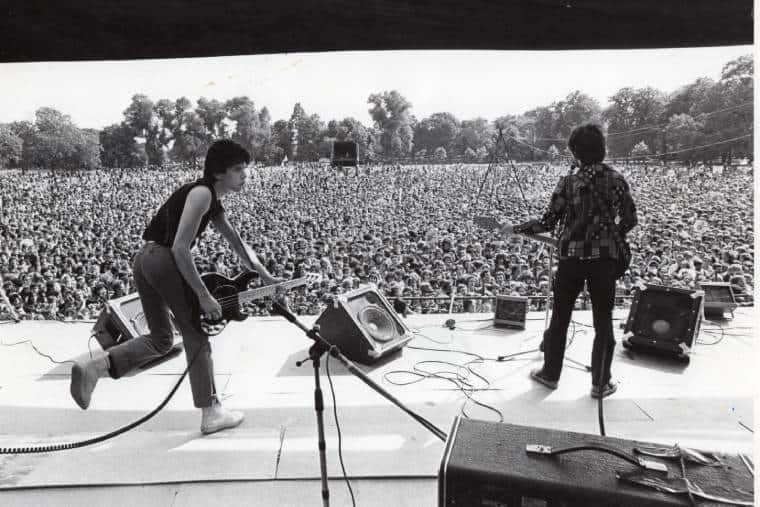
The Buzzcocks at the Manchester Rock Against Racism carnival in 1978 (Pic: John Sturrock)
What was Britain like when you set up Rock Against Racism (RAR) in 1976?
Roger Huddle: There was a swell of racist filth following the expulsion of Asians from Malawi in east Africa. Many of them had British passports and wanted to settle here. The reaction of the press was horrific, and racist MP Enoch Powell resurfaced with talk of repatriation.
In June, 18-year-old student Gurdip Singh Chaggar was murdered by racists in Southall, outer west London. And in late August, cops viciously attacked the Notting Hill Carnival—and black youth fought back. The Nazi National Front (NF) was using the panic over immigration, and disillusionment with the Labour government, to push racist hate.
Geoff Brown: What seemed like endless prosperity for 30 years had come to a shattering end. There was a global financial crash, and a humiliated Britain had to call on the International Monetary Fund for help.
There was a feeling—particularly among young people—that the future had been taken away. And you had this astonishing explosion of anger that found an expression in music, both punk and reggae, in particular.
And the one thing that all frustrated young people connected with was music.
Why did you decide to bring people into the anti-racist movement with music?
RH: In August, guitarist Eric Clapton had spewed racism from the stage at his gig in Birmingham. He ended it with a call to “Keep Britain white.”
That was what set the ball rolling for RAR. We had already discussed how to use our love of music to combat the NF. The fascists characterised all popular music as “jungle music.”
Red Saunders, co-founder of RAR, and myself had both come through the 1960s counterculture, campaigned against the Vietnam War, cheered the French May ’68 events and the workers’ upturn in the early 1970s.
Red, who is a photographer, actor and cultural warrior, wrote a letter to the music press about Clapton’s racism and asked me to sign it too.
I was working at the Socialist Worker printshop and asked if we could use the paper’s PO Box for replies to our call for a movement to fight racism in music.
We had hundreds of replies within days.
RAR was born. Its slogan was, “Reggae, soul, rock ’n’ roll, jazz, funk, punk—our music.”
GB: Nothing captures the explosion of generational anger more strongly than the Sex Pistols’ record, “God Save the Queen.” Complete with its description of the monarchy as a “fascist regime,” it was released during the queen’s Silver Jubilee in May 1977.
We launched the Anti Nazi League (ANL) in November as a sister organisation to RAR. It brought together black and Asian youth, socialists, trade unionists, students, school students, members of the women’s movement and LGBT+ people for the single task of stopping the NF.
I was the ANL organiser in Manchester. We sent around 40 coaches down to London for the first RAR carnival in 1978.
So, over 2,000 people went down, and they came back to Manchester with such an incredible experience. Everybody, I mean everybody, wanted to organise their own carnival.
In that moment hope and horror combined.
Tell us about organising the carnival in Manchester?
GB: So many people were wowed by the RAR carnival that it was incredibly easy to get volunteers to make one in Manchester.
But anybody who’s ever organised anything knows that it’s not simple. But the sense of possibility meant that we had the confidence to be bold.
Bernie Wilcox was the main RAR organiser in Manchester. He pinned down the Buzzcocks to headline our carnival just as the band were nearing the height of their fame.
All kinds of people offered to help in the fight against the NF, not just the bands and the fans. We roped in people in the Labour Party and serious figures in the unions too. This was a real united front.
Having people on board who were politically to the right of my Socialist Workers Party, with sufficient political weight, meant we could get things like parks, money and equipment for the carnival.
How did you keep organising people after these big events?
GB: There was a lot going on. Almost everybody thought there was going to be a general election in October 1978, though it was pushed back to 1979.
The NF said it was going to put up 300 candidates. There were lots of local anti-fascist initiatives. But the idea of a national organisation really took off. The ANL could combine the anger of the youth with others in the working class, the labour movement, MPs and so on. It meant everybody could do something.
It starts with having the ability to make things happen on the ground, at a local level, and using that to convince people that we can do something bigger.
There was a similar mood around the massive Together demonstration earlier this year. But the danger anti-racism faces now is not being bold enough.
We’ve got to use flair, we’ve got to use imagination.
How does the knowledge that we’ve beaten the far right in the past help us now?
GB: I think we’ve got a new generation that can make it happen. That’s what gives me confidence. We are clearly aware of how racism is being used in the most vicious way.
And yet, the reaction to Professor Jason Arday’s death—the 30,000-strong vigil in London’s Trafalgar Square, for example—is inspiring. It showed that we are able to organise for a better future.
Today the bastards will continue to use every dirty trick they can. But we know we have numbers, talent and imagination on our side.
- Reminiscences of RAR: Rocking Against Racism 1976-1982, by Roger Huddle and Red Saunders andA People’s History of the Anti Nazi League by Geoff Brown are both available at Bookmarks, bookmarksbookshop.co.uk