
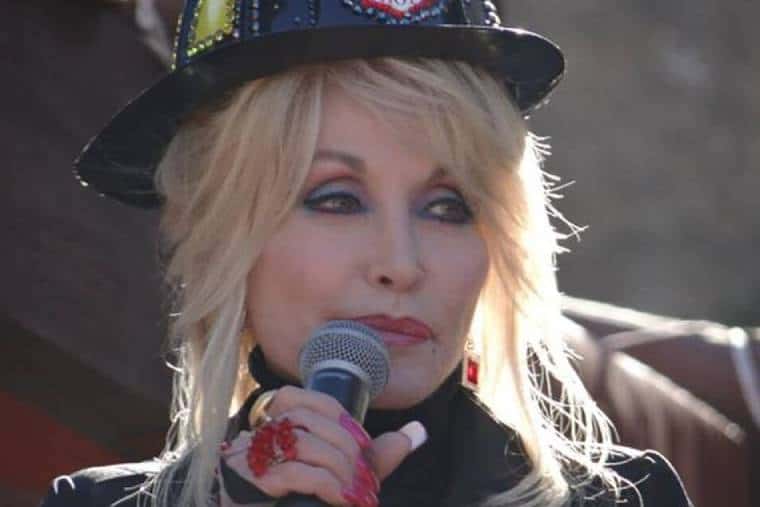
Dolly Parton in 2014 (Pic: Wikimedia commons)
Dolly Parton has captured the public imagination for nearly 60 years as a heroine, gay icon, a caricature and an almost unparalleled musician. She’ll continue to capture the imagination for many decades more after her death on Tuesday.
But the reality of the woman and her work frequently get lost.
Parton was born in 1946 in a one-room cabin in Pigeon Forge, Tennessee. She was the fourth of 12 children.
She sang as a child, first in church and then on television from the age of ten.
By 19, she’d signed with a record company and moved to Nashville. Here, she started chronicling women’s lives in the rural, deeply poor US she grew up in.
There has always been an ideological battle at the heart of country music. It is constantly twisted to back up a right wing, racist, misogynistic agenda.
In truth, it was built by black and working class musicians and has always intended to tell the stories of working class people.
Parton stood in this tradition. Her early albums told the stories of those who were shunned and silenced—stories about abortion, domestic abuse, murderous men and sex.
She described these songs as “real strong pitiful, sad, crying ballads. I love sad songs and I just write about things that maybe I’ve seen happen or things that have been in the family.”
Parton’s early works viscerally talk about women begging god to miscarry babies they can’t raise, women being wrongfully institutionalised for “hysterics”, women being beaten and drowned, women shamed for their sex lives, women suicidal and left hopeless.
Continually, she has spoken, sang and acted on the highly contradictory roles and rights of women.
Her work after she hit big continued to talk about working class women’s lives and moved with the time. In over 3,000 songs, she chronicled the reality of working class life in the US—people “barely getting by, saving everything” they make in the “battlefield of the working man”.
Parton took the insults hurled at her—about her body, her weight, her intelligence—and turned them on their head. “I know they make fun of me, but actually, all these years, the people have thought the joke was on me,” she said, “but it’s actually been on the public.”
The sexual revolution and women’s influx into the workplace were the subjects of her first two films—9 to 5 in 1980 and The Best Little Whorehouse in Texas in 1982.
The film 9 to 5 is particularly interesting, showing the anger and resentment brewing in the workplace.
In it, three women—played by Parton, Jane Fonda and Lily Tomlin—take on the boss. After being sexually harassed, patronised and undervalued, they kidnap him.
After taking over, they start childcare in the workplace and implement equal pay as well as flexible hours and job sharing to allow people to work part time.
Though in the end the boss is brought back, the comedy shows a glimpse of a workplace that focusses on people.
Separate from her image in popular culture, Parton thoughtfully and intentionally funded and supported causes important to her. She lived by the motto, “If I ever get into a position where I can help, I will help, and I think everybody that’s in that position should.”
Since 1988, Parton has funded an education programme in her home county of Sevier County, Tennessee. Quickly the high school dropout rate of the children in the programme fell from 35 percent to 6 percent.
She provided books to some 850,000 children across the US, Canada, Britain, Ireland and Australia through her Imagination Library programme.
She built hospitals, fundraised for HIV/Aids charities and, in 2021 she provided some of the funding for what became the Covid-19 Moderna vaccine.
Parton consistently stood as a voice against racism, homophobia and transphobia.
She was a member of the American Federation of Musicians union for 58 years, constantly offering solidarity and material support for other workers.
Her death is a loss to a great many people. It will also surely be used by those who want to use country music, and all American music and culture, to promote a white, right wing ideology. To allow this to happen would be a betrayal of her life’s work.