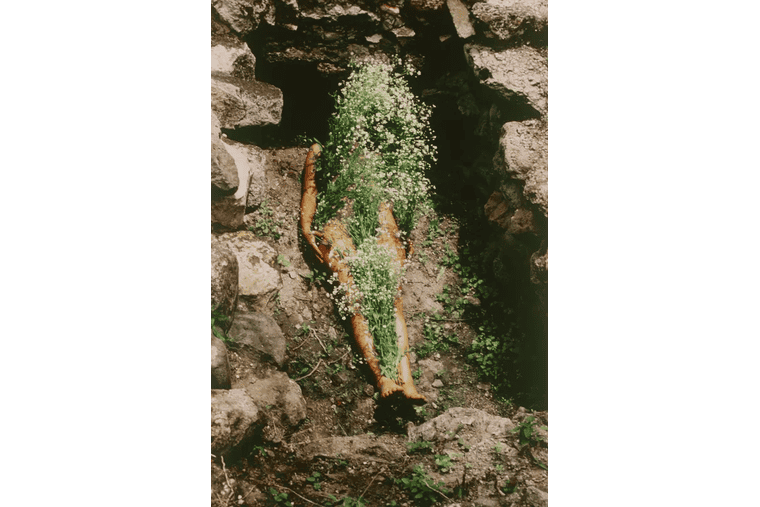
One of over 200 photographs from Mendieta’s Silueta series
Ana Mendieta is an artist whose work is unquestionably rooted in the body and in the self.
This presentation of her work, however, removes nearly all biographic information on Mendieta. This leaves the exhibition feeling hollow. Her body is there, but her presence is absent.
Born in Cuba, Mendieta was moved to the US through Operation Peter Pan, a US government and Catholic-run programme that took children out of Cuba after the revolution. Taken to Iowa, she spent her teenage years in refugee camps, institutions and foster homes.
Mendieta described this as “having been torn from my homeland” which left her “overwhelmed by the feeling of being cast from the womb.”
Her work makes this obvious.
The majority of Mendieta’s art leaves impressions of her own body in natural environments. She did this by making physical imprints, drawing shapes and burning her bodily presence into landscapes.
Video pieces explore visceral physical experiences as she puts her body through shameful and confusing practices.
In one—Blood and Feathers—she pours blood on herself before covering herself in feathers, rolling in them on the ground.
Even in pieces where only the imprint remains we are reminded of physicality. In a series of photographs, we see an imprint in the sand, filled with some red substance, as the tide comes in the imprint is filled, deforming and disappearing, the red dust being taken by the water.
In another series we see the shape of her body burning and turning to ash.
By exploring her presence in geographic spaces, Mendieta mediates some of her feelings and experiences of the tension between being Cuban and living in the US.
Strangely, the exhibition barely mentions this. There is no information on the US’s assault on Cuba, no explanation of the politics behind it and practically no information on Mendieta’s life.
This is particularly bizarre when you come to Moffitt Building Piece, 1973. Through a series of photographs, we see pedestrians walking past a pile of animal innards. We see their shock, their ambivalence, their avoidance over the hours of the day, until in the last photos someone clears the mess away.
Mendieta staged these photographs after the sexual assault and murder of a fellow student at the University of Iowa.
It goes along with her performance piece Rape Scene, though this is not mentioned in the exhibition either.
It is utterly bizarre then, that at no point in the exhibition do the curators tell the audience that Mendieta was probably murdered by her partner.
In 1985, Mendieta fell from a 34th storey window of the apartment where she lived with her husband, artist Carl Andre.
The couple had argued, Mendieta was heard struggling, calling out, “No”, before her death.
Andre claimed they argued over her jealousy at his fame, that she simply “went out the window” afterwards. He was acquitted of any wrongdoing, and her death was ruled an accidental death or suicide.
For years her friends, artists and fans of her work—from the Guerrilla Girls in 1995 to the Where Is Ana Mendieta? symposium, formed in 2010—have drawn attention to her death and the overt misogyny shown in the art world by ignoring it.
By not even acknowledging it, the Tate is leaving the reality of violence against women to fall into obscurity. It is using Mendieta’s body to bring in an audience and not thinking once of the actual woman behind it.
- Ana Mendieta is on show at Tate Modern, Bankside, London SE1 9TG until 17 January, 2027