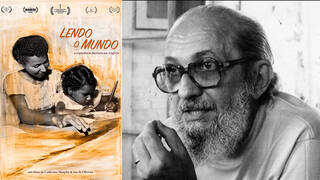
Reading the World is a remarkable new documentary about Paulo Freire, the acclaimed Brazilian educator whose revolutionary approach to teaching connected literacy to critical thinking and democratic participation. It draws on rare archival footage of 1960s Brazil and weaves together the memories of farmers, students and educators who took part in Freire’s culture circles, his method of teaching adults to read in as little as 40 hours by drawing on their own lives, communities and experiences. At the time, Brazil’s illiterate population was barred from voting, so education also opened the door to political participation. The experiment was abruptly halted in 1964 when Brazil’s military overthrew President João Goulart in a U.S.-backed coup that led to Freire’s imprisonment and exile.
“Paulo Freire was one of the most influential educators of the past century and is still widely studied all around the world. But the studies often focus on his ideas, his philosophies, his books, and much less is known about his original praxis,” says co-director Catherine Murphy.
“One of the most important points of his philosophy is that everyone has knowledge,” says Maria Luisa Mendonça, director of the Network for Social Justice and Human Rights in Brazil and a consulting producer.