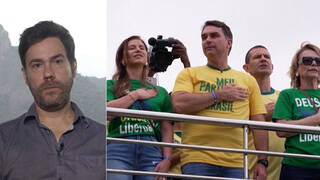
Brazil’s presidential election is headed to a runoff between leftist incumbent Luiz Inácio Lula da Silva and far-right Senator Flávio Bolsonaro after neither candidate cleared 50% in Sunday’s vote, in which the right made gains in Congress and in governor races across the country. Bolsonaro received 47% of the vote compared to Lula’s 45%. The second round of voting is on October 25. If elected, Flávio Bolsonaro has vowed to grant amnesty to his father, former President Jair Bolsonaro, who is under house arrest and serving a 27-year sentence for plotting a coup in 2022 to overturn Lula’s last victory. He has also vowed to strengthen ties to the Trump administration, which is accused of trying to influence the result in Bolsonaro’s favor.
“The momentum has been with the right since 2018,” says Brazilian philosopher Rodrigo Nunes, who explains that public disillusionment with politics is part of that shift. “Lots of people see the far right as promising them, ‘Well, if this is all there is, if all we can expect from the future is ever more dog-eat-dog conditions, an ever more competitive struggle of all against all, at least what the far right says is the state will get off our backs.’”
Nunes is author of Neither Vertical nor Horizontal: A Theory of Political Organization and the new book Anatomy of Disintegration: What Brazil Reveals About the Global Far Right. He recently wrote about the stakes of the Brazilian election for North South Notes.