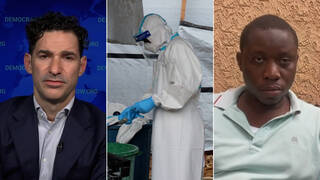
We go to the Democratic Republic of the Congo, the site of the fastest-growing Ebola outbreak in history. Health authorities believe the outbreak first began in January but was not detected until May, in part due to cuts in global health investments, like the dismantling of USAID. Since then, over 8,000 cases have been recorded, with more than 4,000 fatalities so far. From Bunia, Ituri province, the epicenter of the outbreak, we speak to Congolese journalist Akilimali Chomachoma. Chomachoma describes the strain on the underfunded Congolese healthcare system as the disease spreads. Many frontline workers have not been paid for months.
“We are seeing this outbreak emerge, and really unfurl, in a setting of decreased global health support,” says Craig Spencer, a doctor and public health expert based in the United States who contracted Ebola while on a medical mission to Guinea in 2014. “The U.S. has not shown up in the same way that it has in previous Ebola outbreaks.” Spencer also comments on the “unprecedented” measles outbreak in the United States, which he warns is likely to continue and lead to additional deaths.